Fundraising & Investment Strategy

Muhammad Ayub
Thursday, January 8, 2026
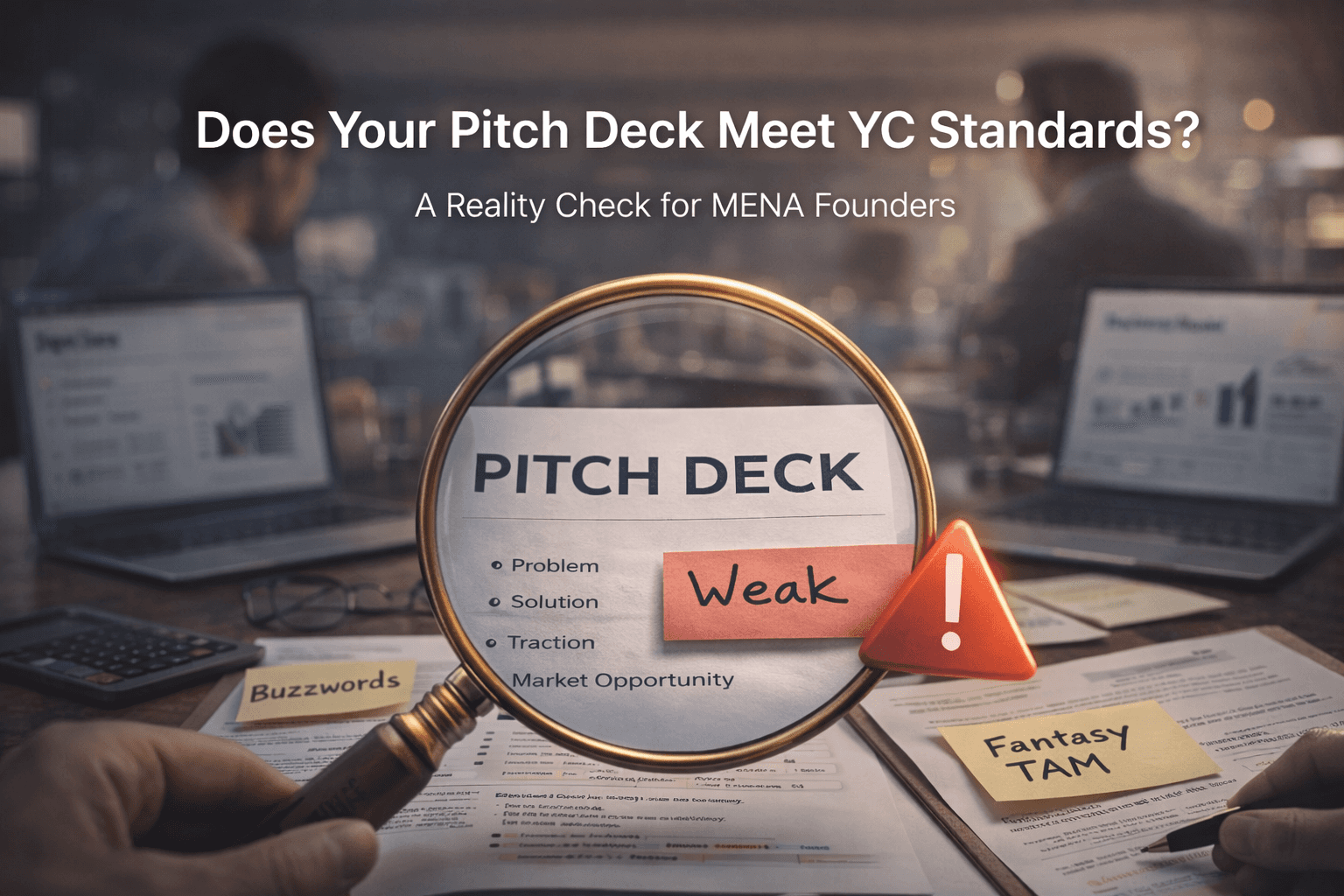
Does Your Pitch Deck Meet YC Standards? A Reality Check for MENA Founders
Here’s what happens to most pitch decks in the MENA region: they get opened, skimmed for 90 seconds, then closed forever.
No feedback. No follow-up. Just silence.
The problem isn’t that MENA founders lack good ideas. It’s that they’re pitching with decks built on guesswork — generic templates downloaded from the internet, filled with buzzwords investors have seen a thousand times.
Meanwhile, Y Combinator–backed companies have raised over $85B using a specific, proven framework. They understand exactly what investors look for, which questions must be answered, and which red flags kill deals before they start.
This isn’t about copying YC. It’s about understanding the fundamental principles that make pitch decks work — whether you’re raising in Silicon Valley, Dubai, or Riyadh.
Why YC’s framework matters (even if you’re not applying to YC)
Y Combinator has funded over 5,000 companies. Their partners have reviewed hundreds of thousands of pitch decks, identifying patterns most VCs simply don’t have data for.
More importantly, many MENA investors have YC exposure — as alumni, LPs, or close observers of Silicon Valley trends. When you pitch using YC-aligned logic, you’re speaking a language sophisticated investors already understand.
But here’s what most founders miss: YC’s framework isn’t about slide order — it’s about logic backed by evidence.
Your deck must answer three questions:
Why is this a massive opportunity? (Market)
Why can you win? (Team + Product + Traction)
Why now? (Timing)
Everything else is support.
The YC 12-slide structure (and why each slide matters)
1. Company / Vision
Your most expansive view of why this company exists — not your product.
2. Problem
A concrete pain point that a stranger can recognize in 30 seconds.
3. Solution
What you’ve built — and why now is the right time.
4. Customer
Specific, clearly defined users. Precision beats ambition.
5. Market Size
Bottom-up, believable, defensible. Not fantasies.
6. Traction (most important slide)
YC considers ~10% WoW growth for multiple weeks impressive.
7. Business Model
Clear unit economics. How users turn into revenue.
8. Competition / Market Landscape
Every startup has competition — even spreadsheets.
9. Team
Why you are uniquely suited to solve this problem.
10. Product Roadmap (optional)
6 quarters max. Fundraise → milestones.
11. Financials (optional at seed)
Actuals matter more than projections.
12. Fundraising / Ask
How much, why, and what it unlocks.
The fatal mistakes MENA founders make
No real traction slide
Fantasy market sizing
Generic problem statements
Hiding behind “stealth mode”
Unrealistic seed valuations
These don’t raise eyebrows. They kill conversations.
The before-you-pitch checklist
Content
Clear traction metrics
Bottom-up market sizing
Specific customer pain
Relevant team expertise
12–18 months runway
Structure
10–12 slides max
One message per slide
10-minute presentation
Documents
Standalone deck
One-page summary
Financials on request
What changes for MENA markets?
Smaller exit markets → tighter TAM scrutiny
Founder pedigree matters more
Clear path to profitability
Regulatory clarity is required
How Morse Bridge can help
You only get one first impression. Weak decks don’t get second chances — they get ghosted.
At Morse Bridge, we review decks against:
YC’s evaluation framework
500+ MENA VC criteria
Real fundraising outcomes
We don’t say “make it clearer.”
We show you exactly how to fix it.
The bottom line
Your pitch deck is your first product.
YC’s framework works because it forces clarity:
Clear problem
Clear advantage
Clear proof
Clear market
Get these right, and you don’t need YC to raise.
You just need to think like they do.
Ready to level up your pitch?
Get your deck reviewed for free: morsebridge.com
Join the Global Fundraising BootCamp (application-only)
Questions? ayub@morsebridge.com
Share It On: